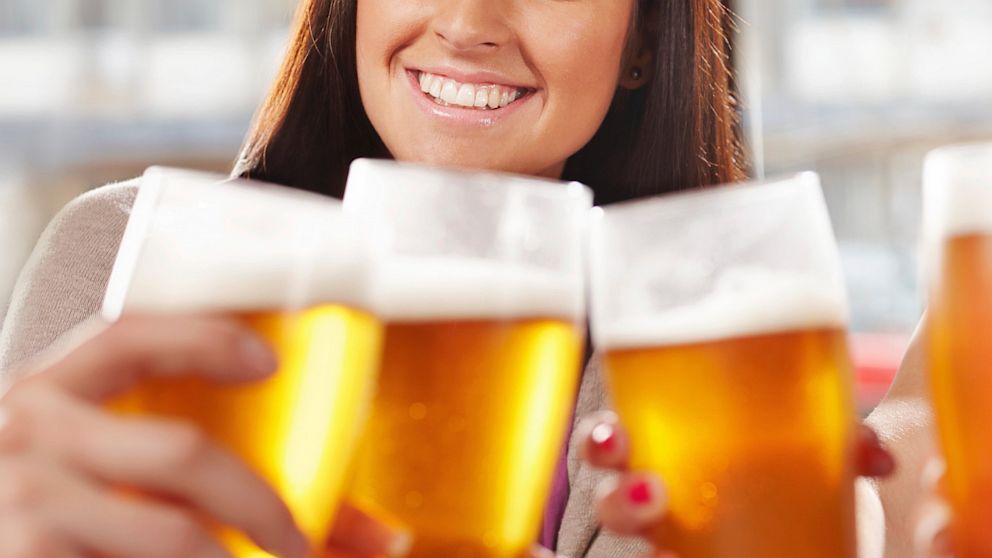
A new type of beer claims to decrease dehydration. | Getty Images Image source: abcnews.com
Whether you're watching the big game at your local bar or playing an intramural kickball game under the influence, beer and sports seem to be a natural pairing.
Even so, if you have one pint too many, you'll be writhing in pain the next day because of nausea and headaches. Is there a way to drink your beer without the fear of the morning hangover?
Ben Desbrow, inspired by the beer-sports connection, ran an experiment to see how beer affected the balance of fluids in the body. Desbrow, a researcher at Griffith Health Institute in Australia, examined whether making beer more like Gatorade and adding some electrolytes would mitigate its alcohol's tendency to dehydrate people who drink it.
"We basically manipulated the electrolyte levels of two commercial beers, one regular strength and one light beer, and gave it to research subjects who'd just lost a significant amount of sweat by exercising," Desbrow said in a statement. "We then used several measures to monitor the participant's fluid recovery to the different beers."
According to the research, published in the International Journal of Sport Nutrition and Exercise Metabolism, subjects lost about two percent of their body mass after exercising and replenished most of the fluid they lost with beer.
The light beer (with 2.3 percent alcohol by volume) fortified with sodium fared the best, helping the subjects retain about one-third more of their body's fluids and urinate less. However, the result was not statistically different than the regular light beer, which had less alcohol than regular beer.
In addition to more research being required on the dehydrating effects of beer additives, there is more to the hangover than dehydration. Michael Oshinsky, the director of preclinical research at the Jefferson Headache Center in Pennsylvania, said that one of alcohol's metabolism byproducts, acetate, plays a big role in the hangover headache.
"We reproduced the alcohol-induced headache in rats," he told ABC News. "If you block the enzyme that breaks down acetaldehyde to acetate, you don't get a headache."
There is also some human evidence for acetate playing a role in the hangover.
"In the past, about 25 percent of kidney dialysis patients said they had whopper headaches," said Oshinsky. "They changed the concentration of the acetate in the dialysis bags, and now it's less than one percent. It's not dehydration that induces the headache."

Find out how important it is to care for the kidneys by reading this blog for Dr. Paul Frymoyer.